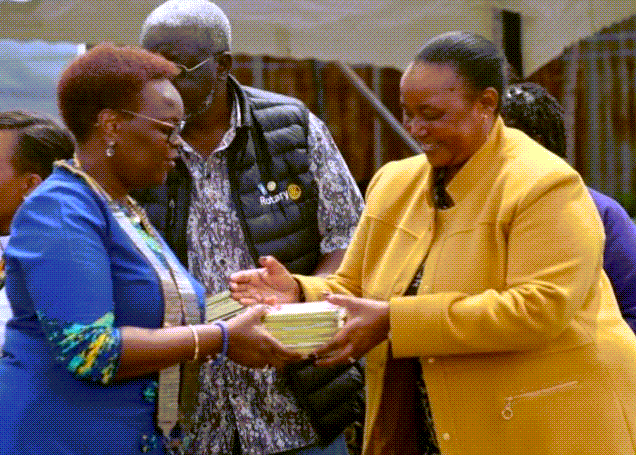
Event Guest of honor: Rotary District 9212, District Governor Wairimu Njage. G presented gifts of math geometrical sets to Kyasila Primary School Head Teacher
Young students are on edge and afraid to walk to school, there’s fear in classrooms and homesteads across the outskirts of Machakos town, Kenya.
This is as a result of rising cases of human–wildlife conflict. The impact of climate change has made prey scarce in the forests and savanna lands. Faced with this predicament, predators such as hyenas and leopards are increasingly venturing into villages in search for food.
Beyond the Kyasila Primary School gates, fear remains real and deeply personal. Residents of Mua Hills near Machakos town, Kenya recount painful hyena and leopard encounters that have left families traumatized and livelihoods shattered.
District 5340 grant P-5857 provided $500 for use in creating an education forum for students, school staff, parents and nearby residents to be educated on co-existence with wildlife, critical measures for preventing human-wildlife conflicts and regaining community peace and trust with Kenya Wildlife Services Police.
The Rotary Club of Athi Kapiti, Kenya used this grant funds to work with the Kenya Wildlife Service (KWS), to step in with a community safety initiative aimed at educating school students and residents how to co-exist with wildlife. The event was held at Kyasila Primary School on March 5, 2026. Charter Club President Silvia Njambi said the focus of the intervention is simple but urgent: protect children while educating communities on how to live alongside predators whose natural habitats now overlap with human settlements. Rotary Club of Athi Kapiti conducted an intensive safety session with pupils, taking them through simulated scenarios of hyena encounters and the actions that could save their lives. The lessons were practical and direct—walk to school in groups, avoid isolated bush paths, remain alert at dawn and dusk, and understand how to react if confronted by a predator. The seriousness of the threat was underscored by Mr. J Dadacha, Deputy Director of KWS Southern Conservation Area, who in his speech acknowledged that the problem has worsened in recent years. The devastating 2022–2023 drought disrupted the predator natural food chain in surrounding ecosystems.
DG Njage thanked the Rotary Club of El Cajon Sunset (across the oceans) for corroborating with Rotary Club of Athi Kapiti to create this much needed education forum on human-wildlife conflict. DG stated that this was “a first of it’s kind grant” in the entire District 9212 as she gave a profound speech.
Local government administrators confirmed that predator incidents are not isolated. Many livestock have been lost and more than four serious attacks have been recorded since 2022, including the death of a secondary school student and the mauling to death of a three-year-old child. The impact on everyday life has been profound. Some parents now send their children to boarding schools at unusually young age simply to guarantee their safety.
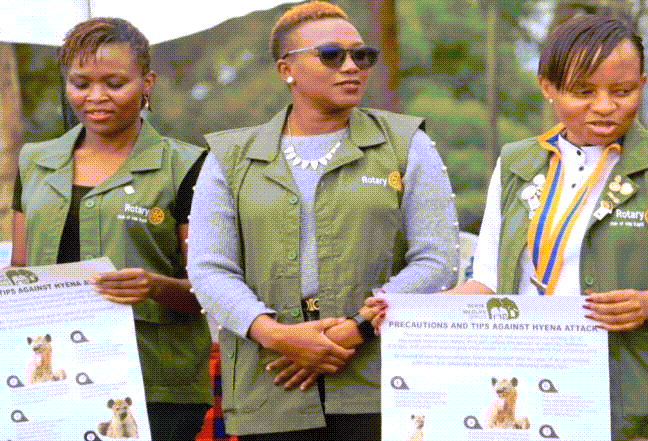
Rotary Club members led by Athi Kapiti Charter President Silvia Njambi right leading a human-wildlife education sensitization at Kyasila Primary School, Kenya.
Evening movement has become restricted, and herders increasingly find themselves fighting off hyenas when livestock is attacked in open grazing fields. Dogs that once guarded homesteads are now locked indoors at night to avoid becoming hyena meal. Their raids on goats and sheep often trigger confrontations with herders determined to protect their animals. These growing encounters raise difficult questions about how communities and wildlife authorities should respond. Gone are the days of hyena folk tales, depicting proverbial greed. Now residents, including children are daylight witnesses.
Conservationists warn that the answer is not so simple; for hyenas play a critical role in maintaining ecological balance. As scavengers and predators, they help control disease and regulate animal populations in the ecosystem.
Eliminating them indiscriminately could disrupt the delicate natural systems that sustain wildlife and Savanna plains. The challenge, experts educated the students, is to find a balance between protecting human life and preserving the natural order. For communities around Machakos town, that balance may lie in a combination of sustained education, better wildlife surveillance, and targeted relocation of animals that repeatedly attack livestock or humans.
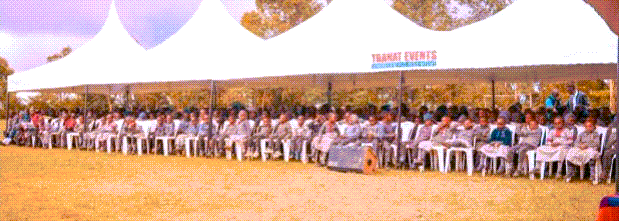
Students received critical wildlife encounter survival skills from expert.
The two Rotary clubs are serving a dire need in the community. Providing education on human-wildlife conflict, needed immediate safety measures and saving lives. This is a testament of the impact and power of a small grant of $500. The grant provided education, created peace and promoted Rotary to more than 1000 people. Without such intervention education as provided by Rotary, residents will continue enduring endless tension between two realities: the need to protect their children and livelihoods—and the knowledge that they share their landscape with predator wildlife.
To commemorate the event, ornamental ant fruit trees were planted at the school.
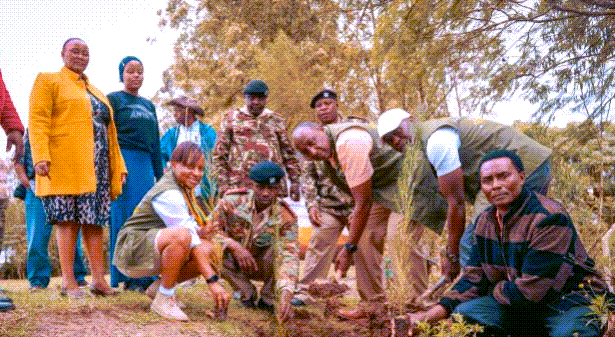
Emphasis on the environment was done by planting trees at the school.